
How Much Should I Invest Each Month?
Reviewed 3 June 2026. A fuller guide to choosing a monthly contribution that fits real life, and to the two ideas that matter more than the figure itself: staying invested, and giving it decades.
The right monthly investment amount is not the biggest number you can force into a spreadsheet. It is the amount you can keep paying, month after month, without making the rest of your finances brittle.
Someone investing £50 a month consistently is building the same habit as someone investing £500. The amounts differ, but the discipline is the same: keep paying in, and never be forced to sell in a bad month. The habit matters far more than the figure. Someone who picks a perfect amount but stops after a year ends up behind the person who paid in less and simply kept going.
This guide is not really about finding a single magic figure. It covers how to choose an amount in the right order and size it against a goal you actually have. But it spends just as long on the two things that end up mattering more than the figure: staying invested when markets are ugly, and giving the whole thing decades rather than years.
Start with the order of operations
Before you settle on a monthly investment amount, check that investing is even the right next step. The same £100 can do more for you reinforcing your foundations than it can in the market, if those foundations are not yet in place. For most people a sensible sequence looks like this:
- cover your essential bills reliably;
- clear or control high-interest debt;
- build an emergency fund;
- then invest for goals that are several years away.
Each step earns its place, so here is why.
Clear high-interest debt first. Paying off a debt charging 22% APR is, in effect, a guaranteed 22% return. No mainstream investment reliably delivers that, and certainly not without risk. While you are carrying expensive debt, such as a credit card or overdraft balance, money is usually better aimed there than at an investment that might average far less. The picture is different for low-rate, long-term borrowing. A cheap fixed-rate mortgage or a UK student loan does not carry the same urgency, and many people sensibly invest alongside them; if you are weighing overpaying a mortgage against investing, the mortgage vs invest calculator lets you compare the two under your own assumptions.
Build an emergency fund next. This is the step most people skip, and it is the one that protects everything else. The purpose is simple: so that a surprise bill or a sudden drop in income never forces you to sell investments at the worst possible moment. A useful rule of thumb is three to six months of essential outgoings held in instant-access savings, kept separate from your day-to-day account. Even a smaller starter buffer is far better than none. You can check whether yours is strong enough with the Emergency Fund Calculator before you commit to a monthly investment.
Then invest for the medium and long term. Once your bills are covered, expensive debt is under control and you have a cash cushion, the money you invest is money you can comfortably leave alone. It is the position from which investing works best, because you are never investing under pressure.
Decide how much: goal-first, budget-first, or both
There are two honest ways to choose a number. One is budget-first: look at what you can comfortably spare each month and start there. The other is goal-first: decide the pot you want, the timeframe you have, and the return you want to test, then work backwards to the contribution that gets you there. Most people land somewhere between the two, and that is fine; the goal tells you what you are aiming at, and the budget keeps it realistic.
One useful reframe is to think in percentages rather than fixed pounds. A contribution set as a share of your income rises automatically when you are paid more, and flexes down in leaner times, so it survives real life better than a rigid figure.
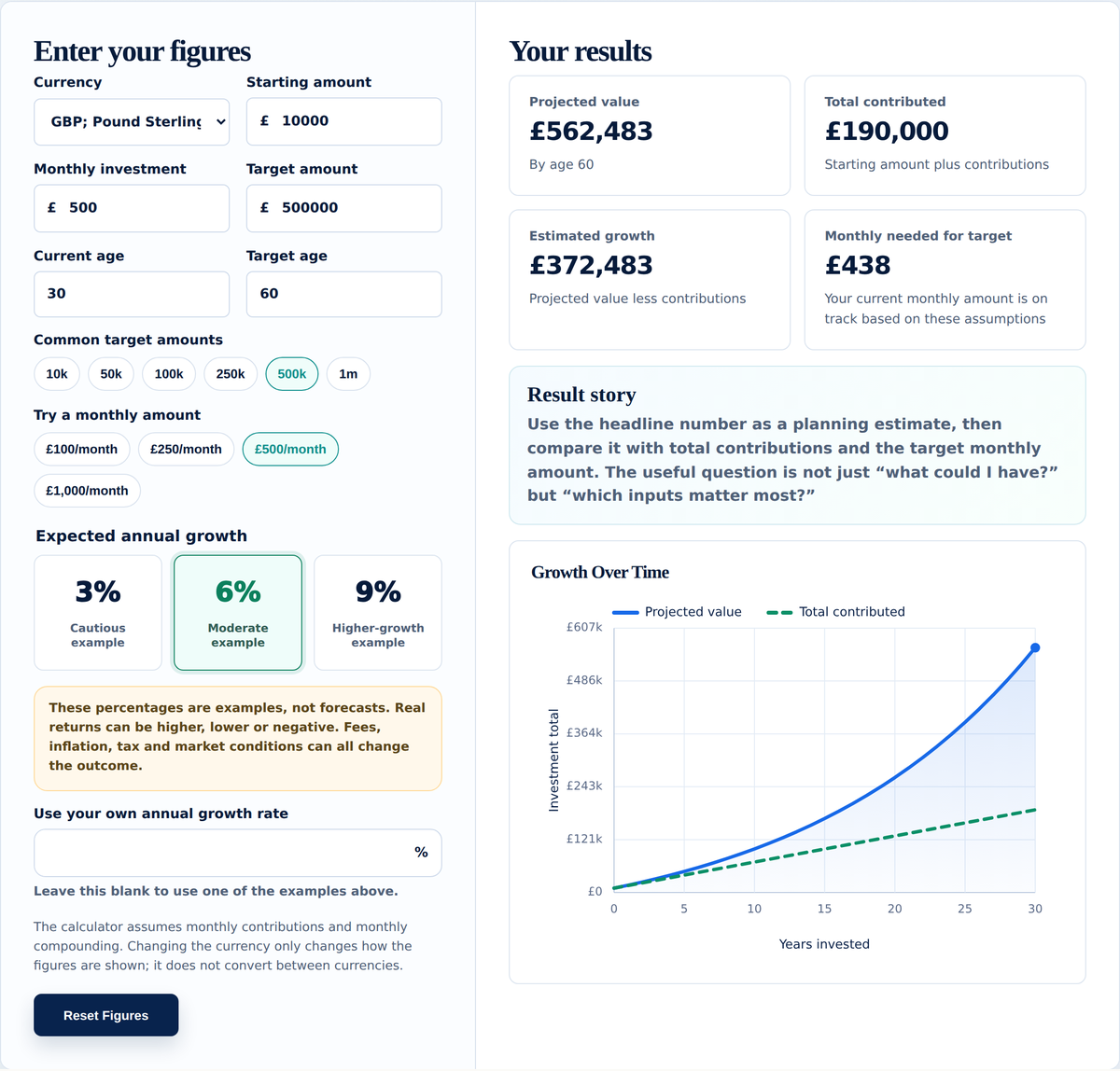
If you want to build a £100,000 portfolio, the monthly amount needed over 10 years will be far higher than over 25 years, so the Investment Calculator lets you change the timeframe and return assumption rather than handing you a single number. The same goal has many different monthly answers, depending on how long you give it.
Start lower than you think, then step it up
It is completely fine to begin below your ideal amount if it helps the habit stick. A modest contribution that survives normal life is worth more than an ambitious one that collapses the first time the car needs work or the boiler packs in.
A practical approach is to choose a base amount you can manage every month, automate it so it leaves your account without a decision, and then increase it at natural moments, such as a pay rise or a debt finally clearing. Redirecting a payment you were already used to making, rather than finding new money, is one of the easiest ways to grow a contribution without it ever feeling like a sacrifice.
Time in the market beats timing the market
Once the amount is settled, the bigger risk to your returns is not the figure. It is your own behaviour. The most common instinct is to wait for the "right time" to start, or to pull money out when headlines turn frightening. Both feel sensible and both usually cost you.
The trouble with timing the market is that the strongest days tend to cluster close to the worst ones, often in the middle of frightening periods. Miss a handful of those rebound days because you stepped out to wait for calm, and you can give up a large slice of your long-run return. Nobody reliably calls the top or the bottom, and money parked on the sidelines is not safe so much as slowly eroded by inflation.
Regular monthly investing sidesteps most of this. Paying in a fixed amount through good months and bad means you buy more units when prices are low and fewer when they are high, and it takes the decision out of your hands. Studies of investor behaviour keep finding the same thing: people tend to earn less than the funds they hold, mostly because they buy after prices have risen and sell after they have fallen. Setting your contributions to leave automatically each month is one of the simplest ways to avoid that trap.
It helps to expect volatility rather than be alarmed by it. A falling market is not a sign something has gone wrong. It is the cost of the higher long-run returns that shares have historically offered over cash. The plan during a fall is rarely to stop. For a long-term investor it is usually to keep contributing, because those are the months your money buys in most cheaply. This assumes a long horizon and a sensible, diversified approach, and it is general information rather than advice about your situation.
Real wealth is built over decades, not years
The last idea is the one that changes how the whole question feels. Compounding, the process of your returns themselves earning returns, is heavily back-loaded. The early years feel slow and slightly disappointing. The later years do most of the work. That should reassure rather than frustrate: starting at all, even with a small amount, matters more than waiting until you can start big.
At an assumed 6% annual return, £200 a month grows to roughly £32,800 after 10 years, £92,400 after 20 years, and £200,900 after 30 years. You will have paid in £24,000, £48,000 and £72,000 respectively; the rest is growth. Look at the shape rather than the totals. The growth in the third decade alone, roughly £84,500, is more than your entire balance after the first decade. Most of the reward arrives late, which is why the years matter more than the monthly figure. These figures are an illustration at one assumed return, are not adjusted for inflation or fees, and are not a forecast; test your own numbers in the Investment Calculator.
Seen this way, "how much should I invest each month" matters less than "how long will I keep going". A smaller amount sustained for thirty years routinely beats a larger amount abandoned after five. Time is the most powerful thing you have working for you, and the one thing you cannot buy back later. This, more than any calculator, is the reason this site exists. For most ordinary people, wealth is the slow product of a habit kept up for a very long time, rather than one clever year.
Be careful with very short timeframes
The flip side of the long game is that investing suits money you will not need soon. If you are saving for something within the next few years, such as a house deposit or a wedding, cash is often more appropriate, because investments can fall in value at precisely the moment you need to spend. For those shorter goals, the Savings Calculator is the more useful tool.
See how it fits your bigger picture
A monthly contribution is only one input into your overall position. Once you have a figure in mind, it helps to see how it fits with everything else: your savings, your pension, any property, and where you are heading over time. That is what the Wealth Planner is for. It brings your savings, investments, pension and property into a single view, projects how that position could change, and compares it against UK household wealth data, so you can see not just what you are paying in each month but what it could add up to.
Useful calculators
- Investment Calculator; test monthly contributions, timeframes and target amounts.
- Emergency Fund Calculator; check whether your cash buffer is strong enough first.
- Wealth Planner; see how investing fits alongside your pension, savings and property.
- Mortgage vs Invest Calculator; weigh overpaying the mortgage against investing.
- Salary Sacrifice Calculator; compare pension contribution efficiency if your employer offers it.
Sources and useful reading
Common questions
Some of the questions this topic tends to raise.
Should I invest before I have an emergency fund?
For most people, a cash buffer should come first. Investing money you may need soon can force you to sell during a market fall, which is the one outcome a long-term plan most wants to avoid.
How much of my income should I invest?
There is no single correct figure. Many people think in terms of a percentage of income rather than a fixed amount, so it rises automatically with pay. The right share depends on your goals, your other commitments and how secure your income is. The aim is a level you can sustain through normal life, not the highest number you can manage in a good month.
Is £100 a month worth investing?
Yes, if it is affordable and part of a longer-term habit. Small monthly amounts can become meaningful over time, especially when increased later, because the habit matters more than the starting size.
Should I invest monthly or as a lump sum?
Monthly investing can be easier emotionally and helps build a habit, and it spreads your buying across good months and bad. Lump sums can be sensible too, but the useful route depends on your cash position and risk tolerance.
What return should I assume?
No return is guaranteed, and real markets rise and fall unevenly. Our calculators let you test cautious, moderate and higher assumptions rather than promising one number, so you can see how sensitive your plan is. The assumptions we use are set out on our methodology page.
What if the market falls soon after I start?
For long-term investing, falls early on are normal and not necessarily bad, because your regular contributions simply buy in at lower prices. The risk to avoid is being forced to sell during a fall, which is what your emergency fund is there to prevent. The usual plan is to keep contributing and give it time.
Should I pay off my mortgage or invest instead?
It depends on your mortgage rate and your other priorities. A low fixed rate leaves more room to invest alongside it, while a higher rate tilts the maths toward overpaying. Our mortgage vs invest calculator lets you compare the two under your own assumptions.
Where to actually invest it
Once you have decided how much, you will need somewhere to invest it. Most UK investors use a stocks and shares ISA for the tax-free wrapper, opened through an investment platform. The Knowledge Hub covers how to start investing and how to choose an ISA platform.
This article is for general information only. It is not financial advice, investment advice or a personal recommendation. The numbers and examples are here to help you understand the trade-offs and do your own research. They cannot tell you what is right for your circumstances.
Investing involves risk. The value of investments and any income from them can go down as well as up. You may get back less than you put in, and past performance is not a guide to future returns. Before making financial decisions, make sure you understand the risks and consider speaking to a qualified financial adviser if you are unsure.