
ISA vs Pension for Basic-Rate and Higher-Rate Taxpayers
Reviewed 7 June 2026. Simplified basic-rate and higher-rate examples that isolate the wrapper choice; not a recommendation. Employer rules and your own tax position can change the answer. Figures reflect the 2026/27 UK tax year.
“ISA or pension?” sounds like one decision, but the answer turns mostly on your tax band and on what job the money has to do. The examples below strip the problem back to the wrapper choice. They ignore investment growth, fees and scheme-specific rules so the tax and access trade-off is easier to see.
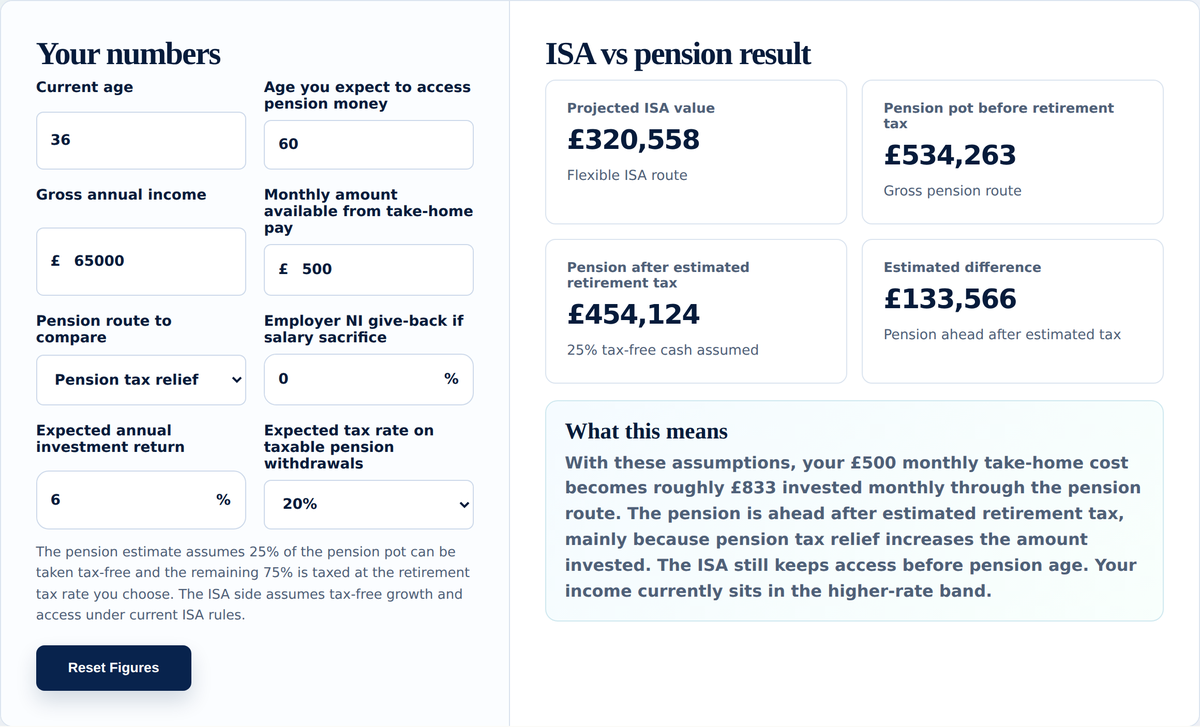
Basic-rate taxpayer: flexibility vs pension uplift
| Route | Take-home pay given up | Amount invested | Main advantage | Main limitation |
|---|---|---|---|---|
| Stocks & Shares ISA | £1,000 | £1,000 | Accessible and tax-free | No tax relief on the way in |
| Pension relief at source | £800 | £1,000 | Basic-rate tax relief added | Locked until pension age |
| Salary sacrifice pension | About £720 | £1,000 before employer give-back | Can save Income Tax and employee NI | Lower contractual salary |
Higher-rate taxpayer: the pension gap gets wider
| Route | Approx. take-home cost for £1,000 invested | Why | When it may suit |
|---|---|---|---|
| Stocks & Shares ISA | £1,000 | No tax relief, but future withdrawals are tax-free | Medium-term goals and flexibility |
| Pension relief at source | About £600 after higher-rate relief | £800 net paid, £200 added by provider, further £200 claimed via tax system | Retirement saving where access is not needed early |
| Salary sacrifice pension | About £580 before employer give-back | 40% Income Tax and 2% employee NI saving in the simplified case | Retirement saving, especially where employer shares NI savings |
Additional-rate taxpayers and the 60% band
Above £125,140 the relief is larger still, at 45%, so for an additional-rate taxpayer the pension’s tax advantage is at its widest. The single most valuable band, though, is the slice between £100,000 and £125,140. There the Personal Allowance is tapered away, which creates an effective tax rate of around 60%, so a pension contribution that brings income back below £100,000 can attract relief of about 60%. The guide to the 60% tax trap works through how that happens.
The employer contribution rule
Before any of this, check whether you are getting your full employer pension match. Employer contributions are not just tax relief; they are extra money paid into your pot. For many employees the first decision is not ISA versus pension at all. It is to contribute enough to collect the full match, then decide where the next pound goes. The order this fits into is set out in which should come first.
The access-age trade-off
ISA money can usually be reached whenever you need it. Pension money is locked until minimum pension age, which is 55, rising to 57 from April 2028. That is not a flaw if the goal is retirement, but it matters if you might need the money earlier, or if you plan to stop work before pension age. For that situation, see the ISA bridge to early retirement.
Test it with your own numbers
Use the Salary Sacrifice Calculator to test pension contributions, the Investment Calculator to model long-term growth, the Retirement Calculator to see whether your saving is on track, and the ISA vs Pension Calculator to compare the wrappers directly.
Related guides
- ISA vs pension: which should come first?
- The ISA bridge to early retirement
- Should I overpay my mortgage or pay into my pension?
- What is the 60% tax trap?
Sources and assumptions
- GOV.UK: Individual Savings Accounts
- GOV.UK: tax relief on private pension contributions
- GOV.UK: workplace pension contributions
- GOV.UK: when you can take your pension
- Your Wealth Calculator: methodology and assumptions
Common questions
Questions people often have about the wrapper choice.
Is a pension better than an ISA for higher-rate taxpayers?
For retirement money you can lock away, usually yes, because higher-rate relief makes each £1,000 in the pension cost about £600 of take-home pay. For money you might need sooner, an ISA can still earn its place.
How much does pension tax relief add for a basic-rate taxpayer?
Basic-rate relief turns about £800 of take-home pay into £1,000 in the pension, a 25% uplift on your money, though most of the pension is taxed when you draw it.
What is the effective relief in the £100,000 to £125,140 band?
Because the Personal Allowance is tapered there, a pension contribution can attract effective relief of around 60%, the most generous band of all.
Does salary sacrifice beat relief at source?
It can, because salary sacrifice also saves National Insurance, and some employers pass on part of their own National Insurance saving.
Is an ISA pointless if I pay higher-rate tax?
No. Its value is access and tax-free withdrawals, which a pension cannot offer before pension age.
Which should I choose if I am not sure when I will need the money?
If access is uncertain, weight toward the ISA for flexibility, while still taking any employer pension match first.
Where to open each
An ISA is opened through an investment platform; a pension through your workplace scheme or a personal SIPP. The Knowledge Hub explains how to choose an ISA platform and what to look for in a SIPP provider.
This article is for general information only. It is not financial advice, pension advice, tax advice or a personal recommendation. The numbers and examples are here to help you understand the trade-offs and do your own research. They cannot tell you what is right for your circumstances.
Investing involves risk. The value of investments and any income from them can go down as well as up. You may get back less than you put in, and past performance is not a guide to future returns. Pension and tax rules and allowances depend on your circumstances and may change.