
What Is the 60% Tax Trap?
Reviewed 4 June 2026. Explains the Personal Allowance taper above £100,000 using UK 2026/27 rules, with worked examples and the £100,000 childcare cliff.
The “60% tax trap” is not a separate tax band, and you will not find it on any HMRC rate card. It is the nickname for what happens when your income climbs above £100,000 and starts to pull away your tax-free Personal Allowance. The result is one of the strangest features of the UK tax system: a stretch of income taxed far more heavily than the income on either side of it, where a pay rise can leave you barely better off, and for some parents, worse off rather than better.
This page explains how the trap works in the 2026/27 tax year, shows the effect at different income levels, and walks through how pension contributions can claw back what the taper takes away.
How the taper actually works
Everyone normally gets a Personal Allowance, the slice of income taxed at 0%. For 2026/27 it is £12,570. Once your adjusted net income passes £100,000, that allowance is withdrawn at a rate of £1 for every £2 of income above the threshold. By the time your income reaches £125,140 the whole £12,570 has gone, because it takes £25,140 of income to remove an allowance of £12,570 at that rate. The trap is the band in between, from £100,000 to £125,140.
The £100,000 threshold has not moved since it was introduced in 2010, and the main tax thresholds have been frozen since 2021. The November 2025 Budget extended that freeze to April 2031. As pay rises over time, more people are pulled into the band each year, with HMRC estimates putting the number in the hundreds of thousands and climbing.
Why the marginal rate reaches 60%
Inside the band, every extra pound is taxed twice over. Take an extra £100 of income while you are between £100,000 and £125,140:
- You pay 40% higher-rate Income Tax on the £100, which is £40.
- You also lose £50 of Personal Allowance. That £50 was shielding income from 40% tax, so losing it costs another £20.
That is £60 of tax on £100 of extra income, an effective marginal rate of 60%. Add the 2% National Insurance that applies on earnings in this band and it is closer to 62%. Income just below the band is taxed at about 42% including National Insurance, so crossing £100,000 lifts your marginal rate by roughly twenty percentage points.
You are taxed on the extra income, and you are taxed again on the tax-free income you lose. Two rules stacking on top of each other are what turn a 40% headline rate into an effective 60%.
The quirk: it eases above £125,140
Here is the part that surprises people. Once your income passes £125,140 there is no Personal Allowance left to lose, so the taper stops. Your marginal rate falls back to the 45% additional rate, or about 47% with National Insurance. That produces an odd outcome: someone earning £125,000 faces a higher marginal rate than someone earning £200,000. The 60% effect is a localised spike inside the band, not a permanent feature of high earnings.
It is based on adjusted net income, not just salary
The figure that matters is your adjusted net income, which is broader than your salary. It includes bonuses, dividends, rental income, savings interest, taxable benefits in kind such as private medical cover, and shares that vest during the year. This is why the trap catches people who do not expect it: a salary comfortably below £100,000 can still be tipped over by a bonus, a strong year for savings interest or a one-off windfall. If you are anywhere near the threshold, it pays to work out your likely total income for the year, not just your headline pay.
For parents, the childcare cliff makes it far worse
If you have young children, £100,000 is one of the sharpest cliff edges in the whole system, because two valuable forms of childcare support are tied to the same adjusted net income figure. If either parent goes over £100,000, the family loses Tax-Free Childcare, worth up to £2,000 per child a year, and the 30 hours of funded childcare for three and four year olds drops back to the universal 15. Unlike the Personal Allowance, which tapers gradually, these are lost in full the moment you cross the line by a single pound.
The effect can be dramatic. A parent with two children in nursery who nudges over £100,000 can lose childcare support worth several thousand pounds on top of the 60% tax effect, so a modest pay rise can leave the family worse off overall. There is also a quirk worth knowing: the test is per parent, not per household. A single parent earning £105,000 loses the support, while a couple each earning £90,000, on a higher combined income, keeps it.
What pension contributions restore
This is where the trap becomes manageable, because the same adjusted net income figure that triggers it can be lowered. Pension contributions, and Gift Aid donations, reduce your adjusted net income, which can restore the Personal Allowance and, for parents, protect childcare support. It is not a loophole, just how the rules are designed to work.
Suppose you earn £110,000 and pay £10,000 into your pension by salary sacrifice. Your adjusted net income falls to £100,000, and the full £12,570 Personal Allowance is restored. Because that £10,000 sat in the 60% band, you would only have kept about £4,000 of it as take-home anyway. So you move £10,000 into your pension at an effective cost of roughly £4,000 in take-home pay, and salary sacrifice saves the 2% National Insurance on top.
The method matters. With salary sacrifice, your salary is reduced before tax, so your adjusted net income falls by the amount sacrificed. With a personal pension paid from your own bank account, your adjusted net income is reduced by the gross contribution, so paying in £8,000, which is grossed up to £10,000 with basic-rate relief, lowers it by £10,000, and you reclaim the higher-rate and allowance benefit through your tax return.
Now add two young children. The same £10,000 contribution that restores the Personal Allowance also brings adjusted net income back to £100,000, which keeps Tax-Free Childcare, up to £4,000 across two children, and the 30 funded hours. The roughly £4,000 of take-home you give up can therefore unlock restored tax relief and childcare support worth well beyond that, which is why this band rewards careful planning more than almost any other point in the income scale.
Things to watch before you contribute
- Check the pension annual allowance, which is £60,000 a year for most people. Very large contributions can exceed it.
- Only contributions that qualify for tax relief or go through salary sacrifice reduce adjusted net income. Money moved into an ordinary savings account does not.
- Keep enough cash for the short term. Pension money is locked away until at least your late fifties, and the minimum access age rises to 57 in 2028.
- A lower salary can affect mortgage borrowing and some salary-linked benefits, so weigh that against the tax saving.
A note for Scotland
The Personal Allowance taper is set by the UK government and applies across the UK, but Scotland sets its own income tax rates, which are higher in this band. That makes the effective marginal rate in the trap higher still for Scottish taxpayers. The figures on this page use the rates for England, Wales and Northern Ireland, in line with our methodology.
See it with your own numbers
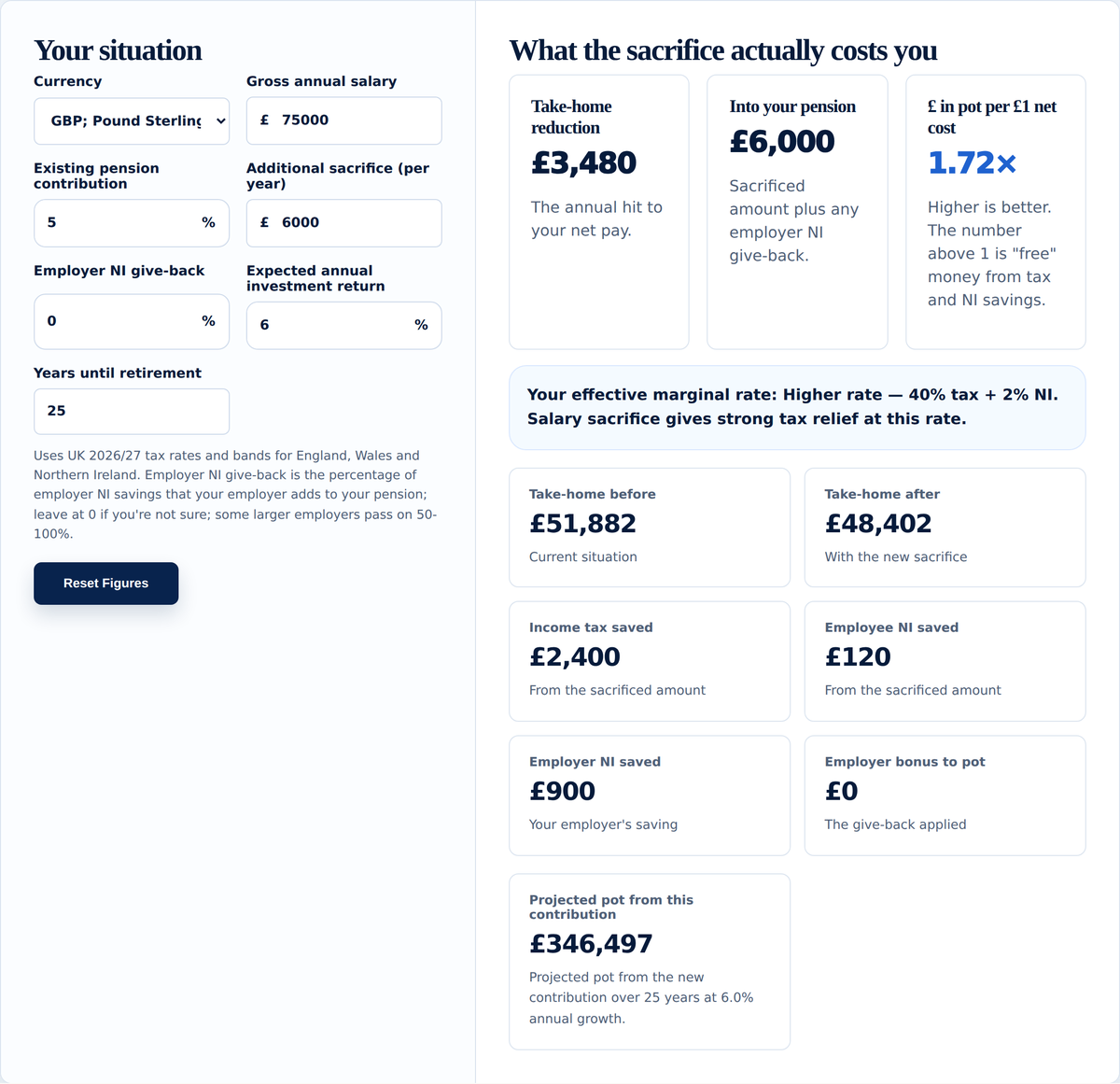
The Salary Sacrifice Calculator lets you compare a pension contribution against the take-home pay you give up, which is the clearest way to see how much a contribution in this band really costs you. It models the Income Tax and National Insurance effects but not childcare, so factor that in separately if it applies to you. For the wider pension decision, see is salary sacrifice worth it? and how much should I invest each month?
See how it fits your bigger picture
Escaping the trap usually means putting more into your pension, which is a long-term wealth decision as much as a tax one. The Wealth Planner brings your pension together with your savings, investments and property and projects how that position could grow, so a contribution made to manage this year’s tax also shows up as progress toward retirement.
Related calculators and guides
- Salary Sacrifice Calculator
- Is salary sacrifice worth it?
- Salary sacrifice examples at £40k, £50k, £60k, £80k and £100k
- ISA vs pension: which should come first?
Sources and useful reading
- GOV.UK: Income Tax rates and Personal Allowances
- GOV.UK: how to work out your adjusted net income
- GOV.UK: Tax-Free Childcare
- GOV.UK: pension scheme rates and allowances
Common questions
Questions that often follow once people understand the taper.
Why does the 60% tax trap start at £100,000?
Because your Personal Allowance is withdrawn once your adjusted net income goes above £100,000, at £1 of allowance for every £2 of income, until it has gone entirely at £125,140.
What is the effective tax rate in the trap?
About 60% on Income Tax alone, or closer to 62% once the 2% National Insurance in that band is included. It applies to income between £100,000 and £125,140.
Is the trap based on my salary or all my income?
On your adjusted net income, which includes bonuses, dividends, rental income, savings interest, some benefits in kind and vested shares. A salary below £100,000 can still be tipped over by extra income.
Does crossing £100,000 affect childcare?
Yes. If either parent's adjusted net income goes over £100,000, the family loses Tax-Free Childcare and the 30 hours of funded childcare, lost in full rather than tapered. For parents this can cost more than the tax itself.
Can pension contributions reduce the 60% trap?
They can. Pension contributions reduce adjusted net income, which can restore the Personal Allowance and protect childcare. A contribution in this band is effectively relieved at around 60%.
Does the 60% tax trap affect Scotland?
The taper is UK-wide, but Scotland's income tax rates are higher in this band, so the effective marginal rate there is higher still. This page uses the rates for England, Wales and Northern Ireland.
What happens above £125,140?
The Personal Allowance is fully gone, so the taper no longer applies and the marginal rate falls back to 45%, or about 47% with National Insurance. Oddly, that is lower than the rate inside the trap.
Where the extra contribution can go
A pension contribution is the usual way out of this band. If your workplace scheme will not take more, or its options are limited, a personal pension or SIPP can be used instead. The Knowledge Hub covers opening a personal pension and choosing a SIPP provider.
This article is for general information only. It is not financial advice, tax advice, pension advice or a personal recommendation. The examples are here to explain how the numbers can work, but they cannot tell you what is right for your circumstances.
Tax and pension rules can change. Where pension investing is discussed, remember that investing involves risk. The value of investments and any income from them can go down as well as up. You may get back less than you put in, and past performance is not a guide to future returns.